XPS Workshop: From Measurements to Scientific Answers


Following the success of the previous workshops "Data Fitting with CasaXPS 2011" and "XPS: From data measurement to scientific answers 2013", a new XPS workshop is scheduled for September 26-30, 2016 (4.5 days) at the CNRS conference centre at Roscoff, Brittany, France.  This workshop is entitled "XPS Analysis: From Measurements to Scientific Answers".

Please note, that the workshop will be held in English and is limited to a maximum of 49 people.  Please click here to find out  more information at the workshop web site:

Workshop program:
1) Theoretical courses on XPS spectroscopy and imaging
2) Practical courses with CasaXPS and QUASES-Tougaard Softwares
3) Training sessions with data and videos supplied
4) Brainstorming dedicated to difficult cases

Parallel sessions:
1) One for beginners
2) One for experts

This training is the opportunity:
1) To gain an overview of XPS, ranging from the measuring technique to data interpretation
2) To explore the possibilities of data processing with the software CasaXPS and QUASES-Tougaard Softwares
3) To create a database of examples of experimental data and their XPS analyses
4) To treat difficult experimental cases, proposed by participants

Workshop Instructors Include:
Dr. Neal Fairley, Casa Software Ltd (UK)
Pr. Sven Tougaard, University of Southern Denmark, Odense (Denmark)
Dr. Mark Biesinger, Surface Science Western, University of Western Ontario (Canada)
Dr. John Walton, TSTC Ltd (UK)
Dr. Delphine Flahaut, Assistant professor, Université de Pau et des Pays de L'Adour, (France)
Dr. Vincent Fernandez, Research Engineer (France)

Polyethylene Surfaces

The C 1s spectrum of polyethylene shows vibrational structure[1] that leads to an asymmetric peak-shape.  If this vibrational structure is not accounted for it can lead to an erroneous assignment of C-OH, C-O-C or an overestimate of contamination/oxidation species[2]. A fitting of a series of polyethylene standards (Figure 1) as well as a fitting of a C18 alkane (Figure 2) on a clean silicon wafer gave consistent peak-shape results and were fit with an asymmetric peak-shape defined in CasaXPS as LA(4.2,9,4) and with peak widths of 0.64-0.65 eV (at 10 eV pass energy) and 0.67-0.68 eV (at 20 eV pass energy). Peak fitting parameters for PE surfaces with small amounts of oxidation and/or contamination are presented in Table 1 and an example is shown in Figure 3. 

Table 1. Contaminated/oxidized polyethylene surface C 1s fitting parameters.
Figure 1. C 1s spectrum of a standard polyethylene sample (20 eV pass energy).
Figure 2. C 1s spectrum of C18 alkane (10 eV pass energy).
Figure 3. C 1s spectrum of a contaminated/oxidized PE surface using the fitting parameters from Table 1.
A similar analysis of polypropylene (Figure 4) gave a peak that can be fit with an asymmetric peak-shape defined in CasaXPS as LA(5.5,9,4) and with peak-widths of 0.82 eV for a 10 eV pass energy and 0.83 eV for a 20 eV pass energy.
Figure 4. C 1s spectrum of a standard polypropylene sample (20 eV pass energy).
References:
[1] G. Beamson, D. Briggs, High Resolution XPS of Organic Polymers - The Scienta ESCA300 Database Wiley Interscience, 1992.
[2] M.J. Walzak, pers. comm. 2015.

Mercury

Table 1. Hg 4f7/2 binding energy values [1].
Notes:
A HgO standard sample gave a Hg 4f7/2 binding energy of 101.5 eV with C 1s (adventitious) set to 284.8 eV. The Hg 4d5/2 was at 359.4 eV, Hg 4d 3/2 was at 378.8 eV, O 1s at 529.7 eV.
[2] shows HgS at 101.0 eV.

Hg 4f7/2 - 4f5/2 splitting: 4.05 eV [2].
Hg 4d5/2: 361 eV
Hg 4d3/2: 381 eV
Hg 4p3/2: 579 eV
Hg 4p1/2: 682 eV
Hg 4s: 805 eV
Hg 5d5/2: 10 eV
Hg 5d3/2: 12 eV
Hg 5p3/2: 67 eV
Hg 5p1/2: 85 eV

Reference:
[1] C.D. Wagner, A.V. Naumkin, A. Kraut-Vass, J.W. Allison, C.J. Powell, J.R.Jr. Rumble, NIST Standard Reference Database 20, Version 3.4 (web version) (http:/srdata.nist.gov/xps/) 2003.
[2] J.F. Moulder, W.F. Stickle, P.E. Sobol, K.D. Bomben, Handbook of X-ray Photoelectron Spectroscopy, Perkin-Elmer Corp, Eden Prairie, MN, 1992.

New Ruthenium 3d and 3p Characterization

An excellent communication in Surface and Interface Analysis from David Morgan[1] presents fitting parameter values for the Ru 3d and Ru 3p peaks for Ru metal, RuO2, RuCl3, Ru(NO)(NO3)3 and Ru(AcAc)3. Binding energies, spin-orbit splittings, asymmetries in the peak shapes and satellite structures are all characterized and presented.
Figure 1. (a) Ru 3d and (b) Ru 3p spectra for metallic ruthenium[1].
Table 2 from [1]. Experimentally determined binding energies and fit parameters for metallic Ru at 20 eV pass energy.
Figure 2. Fitted (a) Ru 3d spectra fro RuO2.xH2O and anhydrous RuO2 and (b) O 1s spectra[1].
Table 3 from [1]. Experimentally determined binding energies and fit parameters for anhydrous and hydrated RuO2 at 20 eV pass energy.
Further Notes:
Using Morgan's original data equivalent LA peakshapes are found as follows:
For the metal at 20 kV pass energy:
Ru 3d5/2 peakshape LA(1.01,1.8,11), FWHM 0.45 eV
Ru 3d3/2 peakshape LA(1.2,1.8,11), FWHM = 0.90 eV

Reference:
[1] D.J. Morgan, Surf. Interface Anal. 47 (2015) 1072-1079.

Beryllium Chemical State Plot and Updated BE Values

A recent rapid communication [1] in Surface and Interface Analysis from Chris Mallinson at the University of Surrey lays out binding energy and modified Auger parameter values (Table 1) for a number of beryllium compounds.  A chemical state or Wagner plot [2] (Figure 1) was derived using a combination of XPS BE and AES KE (Figure 2) data.

Table 1. Auger and photoelectron peak energy values for the four beryllium materials.
Figure 1. Wagner chemical state plot for beryllium.

Figure 2. High resolution AES spectra from all forms of beryllium investigated.
Figure 3. Be 1s XPS spectum of Be metal and native oxide [3].
For further spectra see also reference [4].

References:
1. C.F. Mallinson, J.E. Castle, J.F. Watts, Surf. Interface. Anal. 47 (2015) 994.
2. C. D. Wagner, Farad. Discuss. Chem. Soc., 60 (1975)  291.
3. C.F. Mallinson, J.E. Castle, J.F. Watts, Surf. Sci. Spectra 20 (2013) 86.
4. C.F. Mallinson, J.E. Castle, J.F. Watts, Surf. Sci. Spectra 22 (2015) 71.

Tellurium

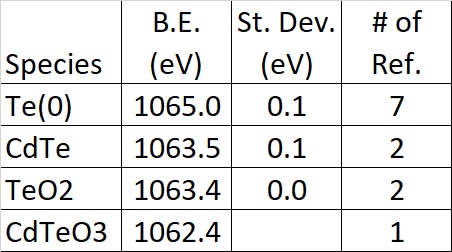
Table 1.  Te 3d5/2 binding energy values [1].
Te 3d5/2 - 3d3/2 splitting: 10.39 eV [2]
Te 3p3/2: 820 eV
Te 3p1/2: 871 eV
Te 3s: 1009 eV
Te 5s: 12 eV
Te 4d5/2: 41 eV
Te 4d3/2: 42 eV
Te 4p: 111 eV
Te 4s 170 eV

O 1s for TeO2: 530.4 eV +/- 0.2 eV
R.S.F. Te 3d = 9.508, Te 3d5/2 = 5.705

Te 3d5/2 - M4N45N45 Auger parameter values [1].

References:
[1] C.D. Wagner, A.V. Naumkin, A. Kraut-Vass, J.W. Allison, C.J. Powell, J.R.Jr. Rumble, NIST Standard Reference Database 20, Version 3.4 (web version) (http:/srdata.nist.gov/xps/) 2003.
[2] J.F. Moulder, W.F. Stickle, P.E. Sobol, K.D. Bomben, Handbook of X-ray Photoelectron Spectroscopy, Perkin-Elmer Corp., Eden Prairie, MN, 1992.

Bismuth

Bi 4f7/2 binding energy data collated from [1].
Bi 4f7/2 - 4f5/2 splitting: 5.31 eV [2]
Bi 4d5/2: 440 eV
Bi 4d3/2: 464 eV
Bi 4p3/2: 679 eV
Bi 4p1/2: 806 eV
Bi 4s: 940 eV
Bi 5d5/2: 24 eV
Bi 5d3/2: 27 eV
Bi 5p3/2: 93 eV
Bi 5p1/2: 119 eV
Bi 5s: 161 eV

Kratos R.S.F. Bi 4f = 9.14, Bi 4f7/2 = 5.223

Reference:
[1] C.D. Wagner, A.V. Naumkin, A. Kraut-Vass, J.W. Allison, C.J. Powell, J.R.Jr. Rumble, NIST Standard Reference Database 20, Version 3.4 (web version) (http:/srdata.nist.gov/xps/) 2003.
[2] J.F. Moulder, W.F. Stickle, P.E. Sobol, K.D. Bomben, Handbook of X-ray Photoelectron Spectroscopy, Perkin-Elmer Corp, Eden Prairie, MN, 1992.

N 1s for Organic Nitrogen Species

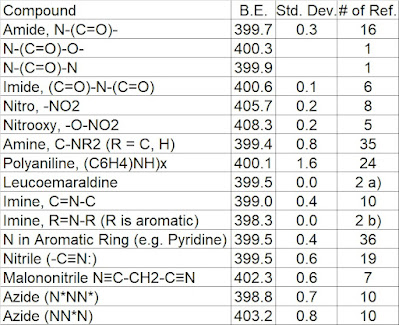
Table 1. Summary of N 1s binding energies [1,2].
a) 399.4 -399.6 eV found for leucoemaraldine [3]
b) 398.3 to 398.5 eV found for emeraldine/pernigraniline [3]

Other species of interest:
Isocyanate (R-N=C=O), 400.0 eV [4] (from bulk methylene diphenyl di-isocyanate)

References:
[1] C.D. Wagner, A.V. Naumkin, A. Kraut-Vass, J.W. Allison, C.J. Powell, J.R.Jr. Rumble, NIST Standard Reference Database 20, Version 3.4 (web version) (http:/srdata.nist.gov/xps/) 2003.
[2] G. Beamson, D. Briggs, High Resolution XPS of Organic Polymers - The Scienta ESCA300 Database Wiley Interscience, 1992.
[4] S. Tardio, M.-L. Abel, R.H. Carr, J.F. Watts, Int. J. Adhes. Adhes. 88 (2019) 1-10.

Tin

Chemical state assignment for tin is difficult due to overlapping Sn 3d5/2 values for SnO and SnO2 (see Table 1.). The Auger parameter and Auger spectral shapes may be helpful here (click for post).

Sn 3d5/2 binding energy values [1].
Sn 3d5/2 binding energy values from standards taken in this laboratory [2].
Sn(0): 484.90 eV, 0.59 eV FWHM at 10 eV pass energy, slightly asymmetric peak-shape defined  by LA(1.2,1.5,5).
Air formed oxide on polished Sn metal: 486.77 eV, 1.61 eV FWHM at 10 eV pass energy
ITO (Indium tin oxide): 486.8 eV

Sn 3d spectrum of a freshly polished tin metal surface [2].
Sn 3d5/2-3d1/2 splitting: 8.41 eV [3]
Sn 3p3/2: 715 eV
Sn 3p1/2: 757 eV
Sn 3s: 885 eV
Sn 4d: 25 eV
Sn 4p: 89 eV
Sn 4s: 137 eV

References:
[1] C.D. Wagner, A.V. Naumkin, A. Kraut-Vass, J.W. Allison, C.J. Powell, J.R.Jr. Rumble, NIST Standard Reference Database 20, Version 3.4 (web version) (http:/srdata.nist.gov/xps/) 2003.
[2] M.C. Biesinger, unpublished results (2012).
[3] J.F. Moulder, W.F. Stickle, P.E. Sobol, K.D. Bomben, Handbook of X-ray Photoelectron Spectroscopy, Perkin-Elmer Corp, Eden Prairie, MN, 1992.

Advanced Analysis of Molybdenum Oxide Peak Shapes

A recent article from Jonas Baltrusaiti (Lehigh University) et. al. [1] offers some excellent insights into the complexities involved in the analysis of the Mo 3d spectra of the three main oxides, MoO2, Mo2O5, and MoO3.

From the Abstract:
Unlike traditional XPS spectra fitting procedures using purely synthetic spectral components, here we develop and present an XPS data processing method based on vector analysis that allows creating XPS spectral components by incorporating key information, obtained experimentally. XPS spectral data, obtained from series of molybdenum oxide samples with varying oxidation states and degree of crystallinity, were processed using this method and the corresponding oxidation states present, as well as their relative distribution was elucidated. It was shown that monitoring the evolution of the chemistry and crystal structure of a molybdenum oxide sample due to an invasive X-ray probe could be used to infer solutions to complex spectral envelopes.


Figure 4B from [1]. The synthetic LF components were summed to form a single complex line shape for MoO2 (green) once a consistent model with the experimental data emerged.*
Figure 9 from [1]. Two XPS fitting models for a Mo 3d spectrum of an amorphous molybdenum oxide sample: (A) Informed Amorphous Sample Model, and (B) Purely Synthetic Model.*
Some key points from this paper to consider for analysis of molybdenum oxides.
1) MoO3 degrades over time under X-ray exposure. The Mo 3d peak shape for MoO3 is a simple spin-orbit doublet.
2) Pure MoO2 has a complex Mo 3d5/2 peak shape showing a two component (see Figure 4) structure. The sharper, slightly asymmetric main peak at 229.3 eV and broader higher binding energy peak at 231.0 eV are ascribed to screened and unscreened final states [2].
From [2] fitting parameters for MoO2 are:
Mo 3d5/2 screened: 229.27 eV (a), FWHM 0.60 eV, weight 1
Mo 3d3/2 screened: 232.47 eV (a+3.2), FWHM 0.75 eV, weight 0.67
Mo 3d5/2 unscreened: 231.00 eV (a+1.73), FWHM 2.14 eV, weight 1.25
Mo 3d3/2 unscreened: 234.21 eV (a+4.94), FWHM 2.21 eV, weight 0.83

3) This complex structure for MoO2 seems to be lost for mixed oxide samples (see Figure 9). The Mo(IV) peak also moves to a higher binding energy. This is something we've also seen in our studies here. An explanation of why this is so is still to be found.
4) Mo2O5 can only be present when Mo(VI) species are also present. Peak shapes for Mo(V) from this work also suggest a two (or more) component Mo 3d5/2 structure. See black line for Mo(V) in Figure 4B.

Some very speculative comments on these results - read at your own risk...
For point 3 - Are we losing the screened (conductive) portion of the Mo(IV) in unconductive mixed oxide samples?
For point 4 - Is the peak shape obtained for Mo(V) using a multivariate approach showing us a multiplet split peak shape (with or without shakeups etc.) or is it showing us the Mo(VI) component that always must be present when Mo(V) is present? This necessary Mo(VI) component will vary with the peak area of the Mo(V) component (and thus will be elucidated as part of the Mo(V) peakshape). Perhaps some theoretical peak modelling may be useful here.

References:
[1] J. Baltrusaitis, B. Mendoza-Sanchez, V. Fernandez, R. Veenstra, N. Dukstiene, A. Roberts, N. Fairley, Generalized molybdenum oxide surface chemical state XPS determination via informed amorphous sample model, Appl. Surf. Sci. 326 (2015) 151-161.
[2] D.O. Scanlon, G.W. Watson, D.J. Payne, G.R. Atkinson, R.G. Egdell, D.S.L. Law, Theoretical and experimental study of the electronic structures of MoO3 and MoO2, J. Phys. Chem. C, 114 (2010), 4636–4645.

* Figures from [1] reproduced with permission from J. Baltrusaitis.